
In our modern world of powerful machines and bustling buildings, there’s an invisible force at play: vibration. From the gentle hum of an air conditioner to the powerful thrum of industrial machinery, vibrations are a constant presence. While often overlooked, uncontrolled vibration is more than just an annoyance; it’s a source of destructive energy that can lead to structural damage, equipment failure, and disruptive noise pollution.
Fortunately, there’s an unseen hero working silently to combat this force: the Vibration Isolator. These essential components are the key to a quieter, safer, and more efficient environment. Among the most versatile and widely used of these are Neoprene Isolators. This guide will explore what they are, how they differ from other types like the Spring Isolator, and why they are a cornerstone of modern engineering.
What Are Vibration Isolators? The Basics of Control
Before diving into neoprene specifically, it’s important to understand the fundamental concept of vibration isolation. Think of your car’s suspension. When you drive over a bump, the springs and shock absorbers compress and expand, absorbing the impact’s energy so that you and the car’s body don’t feel the full force.
A Vibration Isolator works on a similar principle. It is an engineered device or material placed between a source of vibration (like a pump, generator, or HVAC unit) and the supporting structure (like a concrete floor or steel beam). Its job is to decouple the two, creating a barrier that absorbs and dissipates the vibrational energy, preventing it from traveling through the building and manifesting as noise or damaging tremors. Without effective isolation, the energy from a rooftop cooling tower could be felt and heard several floors below, compromising both comfort and structural integrity.
Introducing Neoprene Isolators: The Workhorse of Vibration Control
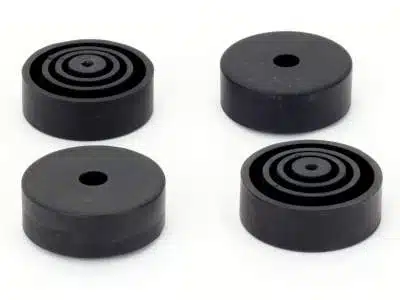
Neoprene Isolators are vibration control components made from a highly durable synthetic rubber called polychloroprene. This material is prized in engineering for its unique combination of properties: it’s incredibly resilient, flexible, and resistant to degradation from oils, chemicals, ozone, and a wide range of temperatures. This robustness makes it an ideal material for creating effective and long-lasting isolators.
These isolators work through a process called damping. As the neoprene element is subjected to vibrational forces, its elastomeric (rubber-like) structure compresses and deflects. This movement converts the mechanical energy of the vibration into a minute amount of heat, which then dissipates. This process effectively “eats” the vibrational energy, stopping it in its tracks.
Neoprene Isolators come in several common forms:
- Neoprene Pads: These are the simplest form—thick, resilient pads of neoprene, often with a ribbed or waffle-like texture. The ribs provide a better grip and allow for more deflection under load, improving isolation efficiency. They are incredibly versatile and cost-effective for a wide range of applications.
- Neoprene Mounts: These are more engineered components, typically featuring a neoprene element bonded within a metal housing (often steel or cast iron). They usually include threaded bolts or studs for securely fastening equipment, providing a stable, isolated connection point.
Neoprene vs. Spring Isolators: Choosing the Right Tool for the Job
While neoprene is a fantastic all-around solution, it’s not the only type of isolator. For heavier-duty applications, engineers often turn to the Spring vibration isolator. Understanding the difference is key to selecting the right tool.
A Spring Isolator consists of a heavy-duty, powder-coated steel spring, typically housed within a sturdy metal frame. Crucially, most high-quality spring isolators also incorporate a neoprene pad at the base.
Here’s how they compare:
Neoprene Isolators 🔵
- Best for: High-frequency vibrations. This is the “buzzing” or “humming” sound typically produced by equipment with high rotational speeds (RPMs), such as smaller pumps, fans, and electric motors.
- Advantages:
- Excellent at damping high-frequency noise.
- Cost-effective and simple to install.
- Compact and requires minimal vertical space.
- Highly durable and resistant to environmental factors.
- Limitations: Less effective for very low-frequency vibrations (the slow “thumping” or shaking) and for extremely heavy equipment that requires a large amount of vertical movement (static deflection) to achieve isolation.
Spring Isolator / Spring Vibration Isolator ⚙️
- Best for: Low-frequency vibrations. This is the type of energy generated by large, heavy, slow-moving equipment like industrial chillers, cooling towers, large generators, and heavy machinery.
- Advantages:
- Superior performance in isolating low frequencies due to their ability to achieve high static deflection.
- Can support extremely heavy loads.
- Limitations: Less effective at damping high-frequency noise on their own, which is precisely why they are almost always paired with a neoprene pad to handle the “buzz” while the spring handles the “thump.” They are also larger, more complex, and more expensive.
The Verdict: It’s not a question of which is better, but which is right for the application. For most standard HVAC and light machinery, neoprene is perfect. For the heavyweights of the industrial world, a Spring Isolator is required. The two work together to solve the complete vibration spectrum.
Key Applications: Where You’ll Find Neoprene Isolators
Once you know what to look for, you’ll see the application of Neoprene Isolators everywhere:
- HVAC Systems: Placed under Air Handling Units (AHUs), rooftop fans, pumps, and compressors to keep the building quiet and comfortable.
- Industrial Machinery: Used beneath generators, industrial presses, lathes, and transformers to protect the factory floor and surrounding areas.
- Architectural Acoustics: Essential in the “box-in-box” construction of recording studios, cinemas, and performance halls, where they are used to acoustically decouple floors, walls, and ceilings.
- Power and Utility: Supporting electrical cabinets and utility equipment to protect sensitive components from operational vibrations.
Sourcing Solutions: Finding the Right Supplier in the UAE
In a region with ambitious construction projects and a demanding climate like the UAE, sourcing high-quality Vibration Isolators is critical. The performance of elastomeric materials can be affected by extreme heat and environmental conditions, so it’s vital to use products designed to withstand these challenges.
Working with experienced Anti vibration pads suppliers in uae is essential. A knowledgeable supplier does more than just sell a product; they provide the engineering expertise needed to make an informed choice. They can analyze your specific needs—such as the weight of the equipment, its operating speed (RPM), and the desired level of isolation—to recommend the perfect solution, whether it’s a simple neoprene pad, a robust mount, or a heavy-duty Spring vibration isolator. A professional supplier will offer a comprehensive range to ensure you get the right isolator for the job, guaranteeing performance and longevity.
Conclusion
From ensuring the quiet comfort of a luxury hotel to protecting the structural integrity of an industrial facility, Neoprene Isolators are the silent, indispensable heroes of modern engineering. They are a simple, cost-effective, and highly efficient solution for taming the destructive and disruptive energy of high-frequency vibrations. By understanding their function and choosing the right isolator for the application, we can build a world that is not only more efficient and durable but also significantly quieter.